In urology procedures, surgical access is a key factor that directly affects precision, visibility, and overall procedure efficiency. Hospitals often choose between URS drapes and urology universal drapes from the Nivda catalogue. While both are disposable and designed for sterility, their effectiveness differs significantly when it comes to access and usability during surgery.
Understanding URS drapes
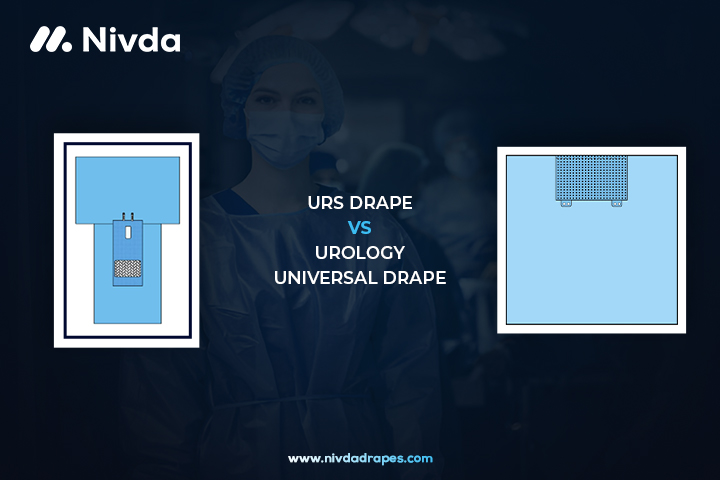
URS drapes are specifically designed for ureteroscopy and other minimally invasive urology procedures. Their structure is focused on providing precise access to the surgical site.
According to Nivda product details, URS drapes include:
- Anatomically placed fenestration for exact surgical entry
- Adhesive edges to secure positioning
- Integrated fluid collection pouch
- Compact and flexible design for instrument movement
These features allow surgeons to work with greater precision and minimal obstruction, which is critical in endourology procedures.
Understanding urology universal drapes
Universal drapes are designed for multi-purpose surgical use, including urology, but they are not tailored to a specific procedure.
As per Nivda catalogue data, universal drapes offer:
- Large coverage area for patient protection
- Fluid-resistant SMS material
- General-purpose design adaptable to multiple surgeries
- Basic fluid control and easy setup
While they provide flexibility, they lack procedure-specific features that enhance surgical access.
Surgical access comparison
| Factor | URS Drapes | Urology Universal Drapes |
| Design type | Procedure-specific | General-purpose |
| Surgical access | Highly precise | Moderate |
| Fenestration placement | Anatomically accurate | Generic or manual |
| Ease of instrument handling | Excellent | Moderate |
| Adjustment during surgery | Minimal | More required |
| Workflow efficiency | High | Moderate |
Why URS drapes provide better surgical access
Precision-focused design
URS drapes are developed specifically for ureteroscopy, ensuring that the surgical opening is placed exactly where needed. This eliminates the need for manual adjustments.
Improved instrument maneuverability
Their compact and flexible structure allows easy movement of scopes and instruments, which is essential in minimally invasive procedures.
Reduced obstruction
Unlike universal drapes, URS drapes do not create unnecessary bulk, allowing a clearer and more accessible working area.
Stable positioning
Adhesive edges keep the drape fixed in place, preventing displacement during surgery and maintaining consistent access.
Limitations of universal drapes for access
Universal drapes provide good coverage but require manual positioning and adjustments to create access points. This can:
- Increase setup time
- Affect precision
- Depend on staff experience
They are more suitable for general procedures rather than highly specialized urology surgeries.
Conclusion
When it comes to surgical access, URS drapes are clearly more effective than urology universal drapes. Their procedure-specific design, precise fenestration, and ease of handling make them ideal for minimally invasive urology procedures.
Urology universal drapes remain useful for general applications due to their flexibility, but for procedures requiring accuracy and efficiency, hospitals prefer URS drapes from Nivda to ensure better surgical performance, improved workflow, and enhanced patient safety.
Get Connected:
+91 76007 27950 | exports@nivdadrapes.com | www.nivdadrapes.com